
A very interesting take on Eric Satie. Thought provoking in many ways.
Musical Rebels: Change Agents
Musical Rebels: Change Agents
 Okay boys and girls, I have a question for you…
I posed a question to my artist guitar class the day of their final exam. The make-up of this class is typically 11th and 12th graders who have been involved in musical performance and study (at varying levels) for upwards of 5 years.
Some of the students have a very high knowledge of music aesthetics, theory, and stage performance. However, that doesn’t always correlate with describing music in a way that is understandable or relevant to a larger, more global view that I was looking for. Sometimes, those with less formal knowledge have a way of giving a more “listener/observer” viewpoint that is more in line with the general public’s viewpoint.
My question to them was:
“Do you think that the musicians who made the most impact on music throughout history were rebels?”
A few disagreed. So, like a good teacher I went on to describe what was really a random idea that came to me. I started with Johann Sebastian Bach and went up to Kurt Cobain . These ideas are, of course, entirely subjective and I’m sure I left many out. But, it is a great topic for discussion and does get music students thinking about making a few waves on their way to fulfilling their own personal goals in musical performance.
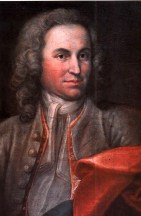 Johann Sebastian Bach (1685-1750) – The use of 7th chords was a bold move by anyone in the 17th century let alone a hard-working church musician/composer from Germany. But J.S. Bach was not to be ruled by anyone. He used 7th harmony to the extreme and boldly set forth a harmonic language that to this day remains head’s above the rest. Moments of jazz and rock spring forth that sound surprisingly fresh and modern. The most astonishing part of Bach’s music was his movement through keys. Like a magician he treated keys as pawns pushing them to their breaking point and finally releasing them allowing them to return home exhausted and spent. Music to J.S. Bach was like child’s play and done so effortlessly that one would have to be a court reporter to keep up with the rules and traditions he shattered.
WA Mozart – Wolfgang Amadeus Mozart started out in the classical style composing his first symphony at age 8 (rebel enough for you?). That he was surrounded by his f ather a composer, and his sister a fine musician and pianist, mattered not. He was the most genius of all musical geniuses. Mozart was not recognized during his lifetime for the powerhouse he was, however by the time he composed his 40th symphony he was headed for music that would surely change the landscape of the art. Had he lived long enough he would have changed music more than Bach himself. But unfortunately, bad health and unhealthy living caught up with him and cut short the most brilliant musical mind in history.
Ludwig Van Beethoven – Was there ever a composer so revered, so influential, so respected, and so feared? No. Beethoven bridged the gap between the classical and romantic periods and by the time he wrote his Late String Quartets (the most incredible four-part musical excursions ever conceived) he had leveled all remnants of the “safe and orderly” classical system. Even today, his ideas still reverberate among us as Beethoven’s life of defiance, drama, and duty still inspire and motivate. We can be comforted in the knowledge that the status quo can be broken, broken by an unorganized genius. Beethoven lived in disorder and chaos as family situations drained no little time from his music. His composing style mirrored his personality. Where Mozart could and would copy music from his head down onto paper with barely an alteration, Beethoven would labor over a section of music for days until he was satisfied. But, never once think that these quirks of personality took one bit of creativity from this ultimate master. Ludwig Van Beethoven set out to change music, to rebel, and that he did. Lesson learned? Yes. Musical sameness can be altered by a brave young genius who cares not what others think or say.
String Quartet No.14 in C sharp minor, Op.131
Claude Dubussy (1862-1918) – By far the most boldly defiant and rebellious composer who ever lived, Claude Debussy unashamedly set forth to dismantle what he saw as uncreative. He despised the method of hanging on to music of the past with its formulaic banality. He was not popular with his music professors and challenged them at every turn. His music was bold and new and this was not met with approval from either his peers or his elders. In and interview, Debussy set forth hi s mission statement clearly: “I myself love music passionately; and because 1 love it, 1 try to free it from barren traditions that stifle it. It is a free art, gushing forth, an open air art, an art boundless as the elements, the wind and the sky. It must never be shut in and become an academic art.” He set forth to change the harmonic language of music and surely put a dent in it. Jazz musicians owe him a debt of gratitude for giving them a new way to stack chordal and melodic tones. Thank you King of Rebels.
My Favorite by far: Prelude to the Afternoon of a Fawn.
Another one of my favorites by Debussy: The Sunken Cathedral.
 Robert Johnson – Nasty, down and dirty; raw and uninhibited, this man, Robert Johnson, would infuse his music with freedom, emotion, and pain and create a legend that will never die. He lived and played like a rebel and without him the blues would never have remained true to its core, an expressive and artistic sonic carrier of feelings and ideas that would change the very nature of music at its foundation. His guitar and vocals were complex and groundbreaking. Never did a blues artist carry such a message, a message of despair and pain that described the lives of blacks living in the south. His music, his blues, was deep going beyond what anyone had ever even conceived before. Robert Johnson, like many other famous musicians (Jim Morrison, Jimi Hendrix, Amy Winehouse, Kurt Cobain) would only live to the age of 27. Johnson’s lifestyle would catch up with him as he was poisoned by a jealous boyfriend just as he was being discovered as a genuine and groundbreaking artist. But in his short lifetime Robert Johnson revolutionized blues guitar and the music that he loved and lived so deeply.
Charley Parker – Has a musician ever improvised like him? Has anyone ever had such a devastating improvisational delivery? It’s almost beyond belief when you realize just how far he took scales and chords. He could improvise on a C major chord all afternoon a nd completely shake that chord to its very foundation. His downfall, of course would be drugs and a slight mental illness that would plague him constantly. However, there was no more fearsome improviser than Charley Parker.
Elvis Presley – Say what you will, this man change popular music forever. His legend will never die. He would take video performance and open the doors for everyone who followed. The King had his faults, but the cult of personality that remains around his memory is astounding. One of the most astonishingly moving performances would be one of his last. There can be no doubt that he single-handedly started a revolution and groundbreaking performances are golden still.
“Can’t Help Falling In Love With You”
“Are You Lonesome Tonight?”
Jimi Hendrix – The man who made the electric guitar sing, literally. Jimi had a language and purpose behind the sounds he made. To him, the guitar was just a vehicle for the ideas that were inside him. I sometimes wonder, as I think he did too, that he was from another world. In the e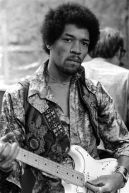 nd Jimi took the electric guitar and totally dismantled it from the inside out opening the way for thousands and thousands of players who still use his groundbreaking sonic experimentations as a foundational part of their expression. The legacy of Jimi Hendrix will always be mixed as there is no escaping the spectre of drugs and excess. However, Hendrix was a soft-spoken and gentle soul who unfortunately became immersed in stardom; too many “friends” (who did nothing but distract him); and the music business itself, which proved once again that it can build up, use, and throw away its own.
“Castles Made of Sand”
Kurt Cobain – Kurt rescued rock music from guitar excess. The 80’s produced a never ending line up of players who played more notes than needed, posed more than necessary. They m ade the electric guitar a musical machine full of repeating gymnastics and blurry thirty-second notes with not one bit of soul or heart in any of them. Kurt took the guitar and brought it to its knees, not with technical proficiency, but with emotion, power, drama, and just plain good song writing. But his contribution would also be to expose the rebellious dark side of
us all. The alternative revolution was not happy music but music that lived on the edge of depression. Kurt Cobain’s unfortunate end will always remind us that the tortured artist syndrome is real.
“All Apologies (Live MTV Unplugged)”
After some thought on this subject ask yourself this question, “Who are the musical rebels of today?” Can’t think of any? Well, maybe music is too watered down and safe and we are waiting.
Mark
MarcusGtr | “She Dreams, She Loves”
via MarcusGtr | Free Listening on SoundCloud.
This is a good example of being ready to move away from preconceived ideas and methods of playing on the guitar. Unfortunately, guitarists tend to develop “comfort zones” in their playing that can become crutches inhibiting true creativity. Not that there is anything wrong with planning ahead and sticking with the script, but being ready to move into an area you hadn’t planned can keep your music alive and relevant.
But, it takes a certain amount of openness, which is directly tied to your musical preference, background, and technique. Typically, we get lost in the technical expression more than anything. We tend to shy aways from things that require struggle and time. We want things now, today…the immediacy of “I don’t want to wait” is death in musical expression, composition, and especially performance. The effort required to refine a technique can become a block to forward movement especially when you want to compose a piece.
During this work, one innocent unplanned slur became the catalyst for the construction of the entire work. Lesson learned. Keep it real and don’t hold back from opening doors that lead you where you hadn’t planned on going.
“The Mountain Stream” – A student’s journey towards the mastery of the score and a teachers paradigm shift.
“The Mountain Stream” is a wonderful guitar composition by Sveinn Ehthorsson. Mr. Ehthorsson runs a wonderful guitar website, The Guitar School http://www.classicalguitarschool.net/en/. I’ve used this site for many yea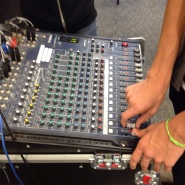 rs in my public school guitar teaching and have been very happy with it. One of my current students, Michael, is working on “The Mountain Stream” for an upcoming evaluation at his high school. He is doing very well so far and we both absolutely LOVE this piece. I have included a recording that we did of the first minute or so of the music. Once Michael completes the piece we will record the entire four pages. The score for the work is available on the website. Here is the sound clip of the first section of Michael’s performance of “The Mountain Stream”. WE recorded it on Pro Tools 9 using a Shure 137 condenser mic about one foot away from his guitar’s soundhole angled in towards the bridge slightly.
The following is a brief look at how Michael has influenced me. Far be it for a teacher to be influenced by a student right? Wrong. If you are not learning from your students then something is out of balance.
 THE STUDENT INFLUENCES HIS TEACHER
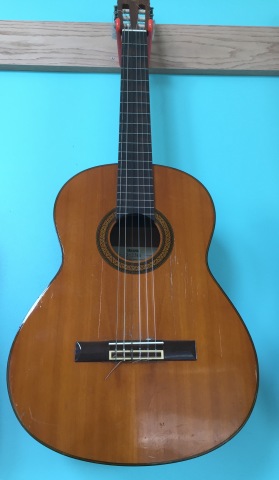
You know I love to create music. Just create. No music on paper. Just a guitar and an idea. However, my conservative side, which is much larger that it may appear, was honed in the early days of my playing when technology was in book form. No aids, no shortcuts, just the music. I learned to play on a Yamaha classical guitar, which I still have at my studio. It is worn, beaten, doesn’t play well, and is fading fast. But, in it is the beginning of a lifetime of guitar playing, studying, and teaching that has brought me further than I could have ever dreamed.
My student, Michael, is discovering this same joy. Michael is dedicated, serious, task-oriented, and talented. I say this because teaching Michael keeps me keenly aware of my roots in music. I love to study music in all forms and to be honest I miss that part of my musical life. The reality is that when you teach and have successful students, you teach more. Your “alone time” with the guitar becomes scarce. It starts to dwindle down to spasms of random time. You begin to realize that you have to fight to stay on top of your musical goals. In the end, I have realized that I must be more like Michael. I must become more focused and driven in terms of working on more structured guitar music. I’ve created a lot of original acoustic music that I’m very proud of, so I am in the process of a shift of priorities in a sense. I want to be Michael again.
Mark
What the Funk? Make it Do What?
A tour de force of funk and hip hop grooves “Make It Do What It Do” was produced by Gemini Jay with Mark Campayno adding smouldering lead and rhythm guitars. Check out the insane runs and legato playing 1:58.
The irresitible groove and infectious vocalizations (my favorite being “turnaround” right before the bridge at 2:40) make for a listening experience that will have you jamming in your seat. I should tell you that this is not candy music. It’s real, fun, uplifting, motivating, not made for or by poser musicians looking to turn three or four rotating chords into easy money. This is music that speaks from the street. The streets of life, hard life, tough and sometimes brutal relationships that burn inside a musician that when released turn into music that grips the soul and fires the senses.
The track starts out with a syn/bass riff that serves notice that these dudes mean business! When Gemini hits the verse things begin to explode with guitar and organ riffs blazing that are reminiscent of something new on the horizon. Could it be? These men are bringing fun back to music? Real groove returning to a groove-starved population. Maybe the beginning of a new funk? Maybe Bruno was right? Uptown Funk is for real? It surely is on this track.
There is no doubt that this pair have a magic all their own when they get together to make music. Gemini produces the track, Mark listens, rips and returns the music to Gemini. Simple right? Yes, for them. But they understand each other. They don’t really tell each other what to do. They just do it. That’s what you call real music.
Both musicians are located in Southern Maryland and Northern Virginia areas respectively. After this release they will surely continue in this vein producing more of their urban insanity. By the way they are both available for tours and gigs.
Check out their other work on SoundCloud and elsewhere. But for your safety I’d stand up for this one! It is the hit!
Allan Inspires – How to Create a Young Mozart in Your Home
Allan Inspires – How to Create a Young Mozart in Your Home
Produced and conceived by Mark Jeffery Campayno
https://www.youtube.com/user/mrcampy123
The Story:
This is a very brief look into the musical life of a young student. Allan started playing guitar at a very young age and since that time he has moved on to at least 19 other instruments. If that weren’t enough he studies performance and guitar at my studio https://www.musicians-inc.com, for his high school, and for the Loudoun Youth Orchestra http://loudounsymphony.org/education-programs/youth-orchestra/.
Allan is one of those musicians who was gifted with the innate knowledge of how to transfer musical systems from one instrument to the next. It’s an intuitive gift that most musicians would die for. But, at its core, Allan is benefitted greatly by incredible parental support and encouragement. This, in my opinion, is one of the strongest indicators of future musical mastery.
Parents, if you have a child who is currently studying an instrument you are part of the process. To let a young musician on his own for all but one hour of a week to deal with the complex physical and mental aspects of musical training is to cut the success rate down to under 20%. Please realize the power you have over your young students future. It’s not an option. You must take at least 30 minutes out of your day to patiently sit and work with your child.
I hear ya…it doesn’t matter that you know nothing about music! Shut off the television, turn off the video games (yes, some of you adults are as bad as the kids), and discover the incredible accomplishment that your child can feel through musical performance.
What is the alternative? Your child hanging out on the street with “friends”, or sitting in front of a computer screen for hours becoming the best video game player in the neighborhood? I ask that your take a moment a realize just how important musical involvement is and how enriching it can be to life. Not only that, you may just find yourself wanting to become a part of it:)
Thank you for your support!
Mark
The Rise of Female Guitarists
Ladies, it’s good to have you. The guitar breathes a collective sigh of relief!
The acc ompanying song is a dedication of sorts to the increasing amount of female guitar players new to the scene. It’s one of the great movements in the world of music performance, education, and recording. Maybe it’s because I’ve taught guitar in public school for 12 years that I am able to see this first hard. With this increased interest, involvement, and desire to play guitar from females the music scene has and will continue to change. It has to right? How can the status quo be maintained when the literal face of guitar playing is becoming more gender friendly?
I’ve always been interested in this movement as myself, and the rest of the guitar staff in the Loudoun County Public School System http://lcps.org touch many lives. The program is understandably vibrant and appealing to many students. We are able to take in many young people who don’t quite fit into the traditional music classes of marching/concert band and choir classes. I fell very fortunate to be in an area of the United States where s a major guitar program for students from seventh to twelfth grade exists. That has had a direct impact on the Maryland, Northern Virginia, and Washington, D.C. area where I work. There are countless examples of students (at least 40% of them female) contributing to the music culture of the this multi-racial and wealthy areas. To give you an idea of the impact this has consider that over the last twelve years I’ve taught and directed around 2,000 guitar/music students. When you realize that they are now out in the world in locations from here to anywhere, you begin to see the impact of that this could be having as the years progress. It’s a female equality victory of sorts without a cause, or, for that matter, a fight. It just happened.
Add to all this the “Taylor Swift” syndrome http://taylorswift.com/ (not negative at all) and you wake up to the reality  that music will never be the same once the full impact begins to manifest itself. Miss Swift has influenced countless young girls to pick up the guitar and play (no pun intended Who fans). But, not just to play, but to sing also. She is a powerhouse in so many ways. Say what you will you naysayers, Taylor Swift will go down in music history as one of the most powerful women in the business, and rightly so.
But, I digress. Of course, the question inevitably comes up, that is, what do females do on guitar that differs from a the male approach? Do they play softer? With more feeling? With more emotion? Oh God, did I say that? Luckily, these tendencies are not limited to female players as these qualities can also be true with males. Not all males approach the instrument like a possession to be lorded over. Moreover, not all women play the guitar softly and tenderly. So the discussion of differences becomes, in a sense, muted.
Whatever the differences are, there is no doubt that the gender difference does produce two differing approaches to the “vision” of and approach to the instrument. If men and women see the world in a way that differs from each other than that will translate to other areas of life and art.
Finally, let me state that if there is one area that is a definite hurdle for some women, it is hand size. That is a topic that I am currently researching. I will have some preliminary results for you very soon.
As for the issue at large, keep the girls coming. The guitar was sorely in need of a female overhaul and damn if we don’t have one right at our front door!


http://www.thecreativeguitar.com/new-original-song-new-spring-new-direction/

What? After all this? “YOU WANT MY GROOVE TOO?”
Time To Call in the Reinforcements. The GROOVE is on! You are Dr. Groovenstein I presume?
Is there anything more important in music than groove? Think of all the great songs that have been written over the years. In all genres and styles, there can be no doubt that the underlyiing feel, or beat in probably the most important element in each of them.
From Beethoven’s Firth, to AC/DC’s Back in Black, the rhythmic pulse augmented by clever instrumentation, is the key to the work’s longevity and further it’s popularity across cultures, age groups, and genders.


“Tears from Above” Ambient Guitar Instrumental.
The state of the world and the creator looking down on it.

- Photo credits
Photo by Nik Shuliahin on Unsplash
Photo by Jon Tyson on Unsplash
Photo by wang binghua on Unsplash
Photo by Karl Fredrickson on Unsplash
Photo by Jamieson Gordon on Unsplash
Photo by Wim van ‘t Einde on Unsplash
Photo by Ivan Jevtic on Unsplash
Photo by Zach Guinta on Unsplash
Photo by Zulmaury Saavedra on Unsplash
 @MarkGTR
