I’ve put this post up in order to “house” the Guitar Pro score of “Fast Car” by Justin Bieber that I transcribed. Some have had a hard time getting the link to work on Dropbox. Sorry about that.
In addition, since it’s a tutorial on the live version I’ve had questions about the basic, and alterations of, the guitar strumming pattern for the song. I’ve also had more than a couple questions about the the outro section. Justin seems to “improvise” his way out of the tune thereby creating some very interesting rhythmic devices. It is a little tricky as Justin has clearly learned a thing or three from Dan Kanter🙂
Here are the links to part 1 and 2 of my tutorial set for Justin’s unique and guitar-friendly cover.
Lorde’s new single Green Light is a study in contrasts for a guitar cover/tutorial/play-through. It’s the kind of song that grows on you after a couple listens. But, still you sit and ponder. It is worth it? But then you realize that this one has something to work with, it does have merit after all! After listening to what seems like a patchwork of disjointed ideas scattered about it soon becomes clear in the mind of the listener that Green Light does what all pop songs are programed to do.
The content is not heavy. Basically, we have a 5 chord pop song like many others. Where as Green Light revs up slowly and patiently, most pop songs don’t have the patience for such maneuvering as their game is always centered on getting to the point early and often. It’s a mainstay of popular music. Lorde, is a “developer”. Her tendency is to take sparse material and dial things up as the minutes pass. Green Light is no exception,
The pre-chorus/chorus sections are a thing of lighthearted genius as a masterful but typical riff takes over that lights up the song with such energy that even Lorde can’t stay in control (check 3:03 of the video).
For your part, keeping the chorus riff even and controlled is no easy task on guitar, especially acoustic. Keep your right hand solid and bear down on the strumming pattern. That is, if you are covering it at it’s recorded tempo.
I can see this section played a little slower without damaging the intention of the writer. Experiment and see what you come up with.
Say what you will about pop music, but it does have quality players and producers if you look for them. Take this performance by Julia Michaels with Dan Kanter on guitar. It’s nothing but beautiful and expertly performed. Dan Kanter is the best guitar accompanist around. His work on Justin Bieber’s acoustic “What Do You Mean” opened up the world to just how good a guitar part can be behind a pop vocalist.
Why Dan?
Dan raises the bar when it comes to harmonic choices in his playing. Give him three chords, four chords, five chords, it matters not. Dan will take what are usually easy throw away guitar forms and turn them into incredible soundscapes that lift the song beyond what most would deem possible.
Dan’s Method
In this song, Dan has tuned his guitar up one half step. Oh that Dan, you never know what he has up his sleeve. This will, of course, put more stress on your fingers as the string tension will be higher. Don’t worry if you have a smooth playing acoustic. If not, be advised that your fingers may not be happy with you. Read on for a couple solutions I’ve come up with.
For her part, Julia Michaels was nothing short of fabulous. Maybe a little nervous at first? Well, who would fault her. The nervousness did not last long as Dan’s guitar lifted the session and Julia picked up on that energy immediately. Her vocal performance is fabulous and I would dare say that it rivals the original. A wonderful artist in her own right she has also co-written works for Justin Bieber and Selena Gomez! This gives her big street credentials and should keep her busy for quite a while.
Solutions to the Dan Dilemma
My solution to the “tuned up” Dan guitar was to simply capo on fret one. The only reason I did this was to avoid the obvious sound of breaking strings as people who watch this tutorial attempt to tune up. Heaven’s no. I’m not going to be responsible for that mess. Another solution? Play it in the original key of Ab major. One warning, you will all but lose any open strings. My advice is to either capo, tune up, or play in open position (without the capo) and sing it in the key of G major. Whatever you chose will depend on your experience and finger strength.
And Finally…
Have fun with this upper intermediate to lower advanced guitar part and please, don’t ask me to make it easier for you. It would be irresponsible of me to do so. Hey, eventually you have to deal with the reality that playing guitar is hard work and sometimes you have to step it up and push yourself.
Ed Sheeran’s new song “New Man” is just what the doctor ordered for those of you who need to get over your fear of barre chords. This phenomenon seems to be occurring more and more and the guitar Capo has pulled many away from the dreaded process of learning to get those fingers holding down multiple strings.
But as luck would have it, along comes Ed to help you deal with the inevitable. “New Man’ consists of five chords. G, E minor, D, C, and B minor. All chords are played with 5th string roots and nary a once do you touch the 6th or 1st string.
Here are your chord forms:
G Major 10th Fret)
E Minor (7th Fret)
D Major (5th Fret)
C Major 3rd Fret)
B Minor (2nd fret)
Song Form:
There are only two chord patterns used in the song:
Pattern 1 is as follows (mainly during the intro and verse):
E Minor-G Major-D Major-E minor-C Major-B minor-D Major-E minor
As you can see, E minor is the central focus of the progression giving us the expected minor tonality that matches the lyrical content of the verses.
Pattern 2 is played during the chorus and bridge sections, that progression is as follows:
G Major-D Major-E minor-C Major-B minor-D Major-E minor
The G Major lead in this section brings a nice contrast to the chords and gives the song the rhythmic lift it needs to launch us into the somewhat more hopeful chorus section.
As for how to deal with barre chords? I recommend starting them on electric guitar (if you have one) and once you produce a good clear sound, transfer over to acoustic. If you wish, stay on electric. Use a clean tone with light reverb or chorus.
As for playing the chords, do not use a pick but rather articulate each chord with your thumb, index, middle, and ring fingers. You can add a tap after each chord however, know that Ed doesn’t over-emphasize that technique in this song. I do it just to mark the rhythm of the pattern.
Take your time with this one. Move back and forth through the chords making sure you are accurate with both right and left hands.
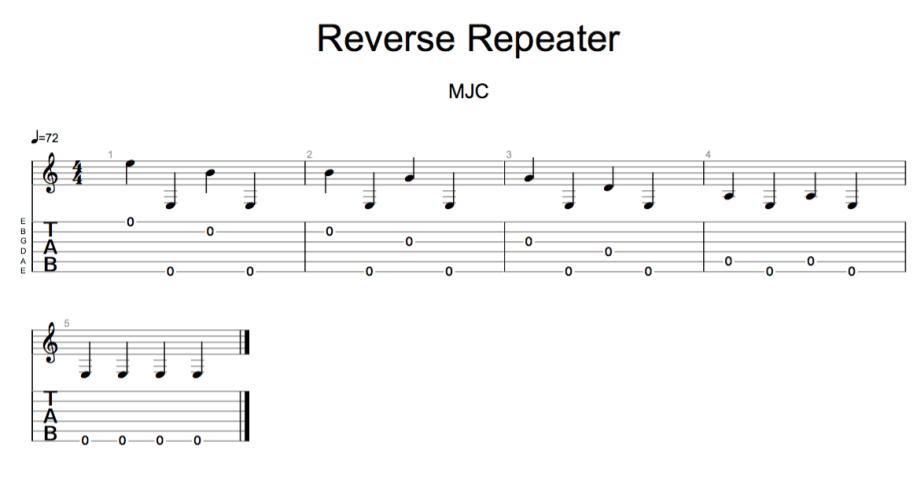
This is a right hand exercise using only the right hand thumb and index finger.
It is a little tricky at first as the movement collapses from the top to the bottom (lower) 6th string. In order to keep the exercise within the first year limitation, the thumb plays on the 6th string only.
*Keep in mind that we are working towards the Travis Style of picking and in that vein, you will use both the index and middle fingers on the upper three strings.
Please take your time with this going slowly and carefully. This will develop your ability to play more complex patterns with independence between the thumb and the index, middle, and ring fingers.
“Town Theme” written by the prodigious Anime composer Nobuo Uematsu, is a short but alluring piece of music. Consisting of a light texture with a hypnotic rhythmic movement, the melodicism embedded in the sections gives it the staying power it needs for its role in the game, Final Fantasy.
I chose to cover “Town Theme”theme using a acoustic guitar duo format. My obsession with random improvised harmonies was perfectly suited to the music’s construction. Not that the work needed my help mind you, it was just my way of interpreting the “hidden harmonies” one hears when the obsession with music runs deep in your brain.
Like all great composers Uematsu gets to the techniques that color otherwise plain tonal music. This is where the theme becomes legend. An ordinary composer would struggle to rise to such heights with such a project. Writing of this type can be an exercise in frustration as the limitless creative powers one has are kept at bay due to the reality of keeping the music close to home in terms of listenability and ultimately, commercialism.
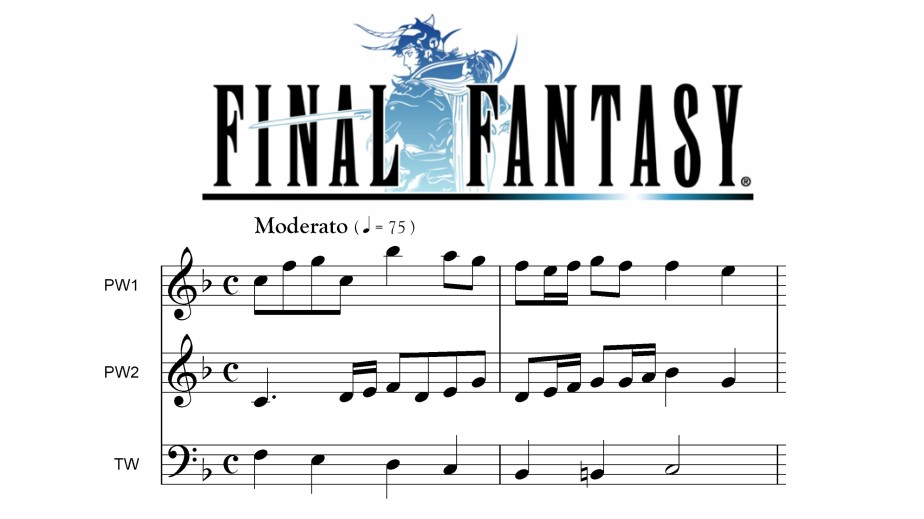
The first few seconds of “Town Theme” are telling. A very clever two-measure introduction opens with an artful C major arpeggio. In the following measure the composer wastes no time and goes for the gold medal with a beautiful second-inversion iv6 chord. The Fm/C substitutes for the dominant (as it’s prone to do) giving measure 3 the push it needs to move forward like a bright, sunny, and brisk Sunday afternoon drive.
In measures 9-10, an absolutely perfect cadence is set up to put and end to the first melodic statement. The progression, V I vi V2 bVI I5 V I is nothing short of mesmerizing.
Is it genius writing? Maybe not being that the role o the theme is to bring one back to the center. But, I would challenge you who are composers to attempt such writing using the obvious restrictions during your process.
You will come out a better writer as you reach deeper into multi-part writing. Keeping track of all voices and rhythms at your disposal your creative power will grow.
This is a nylon-string cover of the beautiful ” Bratja (Brother)” written by Michiru Oshima.
Here is more information about the song that will put things in context:
Brothers (Russian: Братья, Bratja; Japanese: Buraacha) is a song composed by Michiru Oshima for the anime Fullmetal Alchemist. It can be found on the first Fullmetal Alchemist O.S.T.. Other orchestrated versions can be found on Fullmetal Alchemist O.S.T. 3 and the Fullmetal Alchemist: The Conqueror of Shamballa soundtrack.
The song is about the Elric brothers, Edward and Alphonse, and their feeling about the tragic incident that happened at the very beginning of the series. They attempted to resurrect their mother who had died of an illness. However, during the transmutation, Alphonse lost his body while Edward lost his left leg, and, consequently, his right arm.
In the first verse, Edward expresses his grief and regret for pushing his brother into doing the transmutation with him. He blames himself for what happened, admitting that “there is no cure for death”. Alphonse, in the second verse, attempts to console him. He urges Ed to forget whose fault it is, as they both chose the same path, so neither of them is more guilty than the other. In each of the choruses, they sing about how much their mother meant to them, but how their tries to bring her back were in vain. In the final stanza, both brothers question where they should go from where they are now after realizing that it is impossible to bring back that which has been lost.
Another version of the song was recorded in english by Vic Mignogna, the voice actor who played Edward Elric in the series.
Here are the lyrics translated into English:
Bratja (Brother)
Forgive me, younger brother
I am to be blamed
It is impossible to return
that, which has been taken by earth
One that knows the law
would help me find the answer.
I made a terrible mistake,
there is no cure for death.
Dear Mother! So Soft! (soft as in loving)
We loved you so much.
But all our powers
were spent in vain.
I intrigued you
With the perfect hope
To return our family
My brother, the blame is all mine.
Don’t cry, don’t despair, older brother
You are not the only one to blame
We both have one road
Lets bury the blame to the depth (meaning lets forget whos fault it was)
I can’t blame you for anything,
And I hold no hard feelings. (as in Im not mad at you)
Heavy is our cause
The desire to be stronger than all
Dear Mother! So Soft!
We loved you so much.
But all our powers
were spent in vain.
I was intrigued myself
with the wonderful hope
to return our family.
I am the one to blame.
So what do we do now?
How do we correct and forget?
When you can’t return
That, which was been taken by earth.
One thing is sure, people still love live music. If there was any worry that is was slowing down that’s surely gone. Fans want the real deal. Audio improvements, ease of downloading music, and the saturation of music in the media have not dimmed that internal desire for live performance. Our GM put it best when he said that “the business is healthy, and business is good”. The pubic’s desire to become, as it where, part of the experience continues to bring them to venues in droves.
Jiffy Lube Live Bristow, Virginia
All of us deal with concert goers that come up to us pleading that they know someone in the band. I knew rock stars were “prolific” but I didn’t know it spread so far. My reaction is always “You don’t say?!” “How do you know him?” Crickets…:)
Rob Zombie’s set smoked. He sounded great and to be honest, for a few moments I forgot who the headliner really was. I kept thinking, “How can the show get any bigger than this?”John 5 played a blistering four minute long guitar solo during Rob Zombie’s covert walkathon through the crowd. Ya, maybe a little cliche at times but still great. It’s about time he was allowed to cut loose. It wasn’t going to happen with Marilyn Manson as the music wasn’t about long guitar solos. But with Rob’s vibe, it fits perfectly.
Zac Brown’s horn section ripped out some of the most thrilling lines I’ve ever heard during their spotlight. For sure horns in a country band are unusual. Credit has to be given to Zac’s vision of the band as the variety of instruments in Zac’s music is what creates the magic.
Korn has to have the largest female following in Metal. Easily. I’m not saying I have the reason for it, it’s just a fact. What does it mean? I dunno, maybe there’s something to be learned here for other bands who carry a heavy “guy” fan base.
We like Korn. And?
Breaking up fights during shows is dangersome and delicate. But, there is an art to it. One things for sure, a girl fight is the dread of us all.
Can’t we all just get along?
Zac Brown’s cover of The Who’s, “Baba O’ Reilly” was explosive. The keyboard part at the beginning could have been tweaked a bit better but nevertheless, it was refreshing to see fans of all ages singing along. It was a genius move to cover that gem.
I still don’t understand mosh pits. How more young people are not injured is beyond me. Flailing arms, karate kicks, muscular hulks with fire in their eyes, females fearlessly running around impervious to the danger. It’s interesting to watch but that doesn’t make it any more understandable to me. But…hey, it’s there and it’s part of what makes this music burn.
Hey man you off my shoes!
Korn’s music has a unique element in it that produces an aggressive and hyper-ecstatic reaction in its fans. What that element is centers around their unique harm and very tight and compressed sound. There were moments when it felt as though the venue was about to go nuclear.
Zac Brown’s music is at times fun, sad, reflective, lively, and safe. But, when he hit the stage it all changed. The high-octane crowd took it to another level. Zac rocked hard. I must say I was pleasantly surprised! Be assured that Zac Brown is the real deal. He runs a very well oiled music machine and they are tight.
Zac can rock!
The key to being good at working on the floor during high energy shows is a very keen sense of people. If you can’t read a situation instantly you won’t make it. You have to look, evaluate, judge, and keep your eyes moving. Other than that it’s a piece of cake.
Hold on while I read you.
Experience. There is no substitution for it. Every show, every situation, and every moment is an opportunity for growth and movement forward. This is the greatest job I ever loved.
-Mark
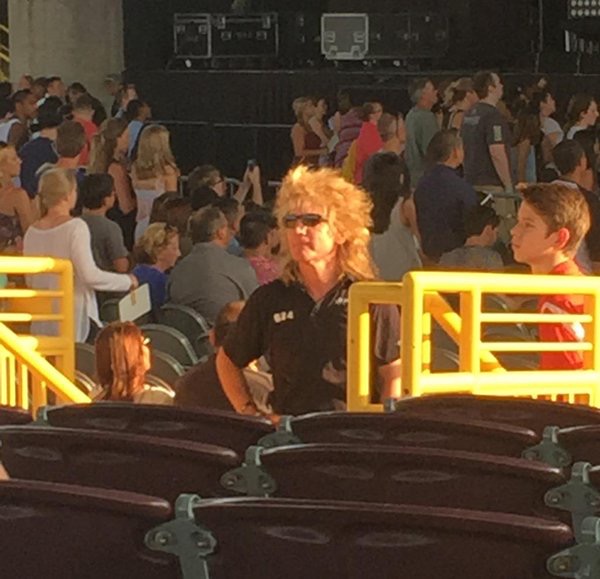
Scanning the incoming crowd.
Mark Jeffery Campayno runs a music performance studio, Musicians-inc/StudioRock of Northern Virginia. Mark also directs the guitar department at Broad Run High School in Ashburn,Virginia. He also works on the pit crew at Live Nation’s Jiffy Lube Live Pavilion in Bristow, Virginia, and hosts his own internet radio show, The Studio Rocks at http://www.jazzbites.com.
Okay, I admit it. I have been annoyed by Adele’s music. Why? Well, it turns out that I’m as susceptible to radio/media overkill as much as anyone. However, On July 25th 2016 at approximately 2:30 pm I was sitting at a red light about a half mile from the studio.
Lo and behold I hear this music…this guitar and bass drum. Then, I hear the voice. Instantly, I knew it was her. I’m thinking no not again! But, this was different. This song cut through my musical being like a knife. The songs ends and the light turns green. I rush into the parking lot, into the
I dial in the song on YouTube and the studio and drop everything.That day, and my opinion of Adele changed. This two-chord guitar gem has taught me another valuable life lesson. Judging based on how you think things are is a tragic mistake. The wonder woman of music has done it again…lest you think you can be this creative with just two chords an acoustic guitar and a drum:) Okay, enough of that.
Here is what I have so far of the guitar and percussion part for the song. I will have it finished tomorrow and will turn this into the finished product. This should suffice for the next 12 hours.
A Nylon String Guitar Original Work Prelude This “classical guitar” work in the new acoustic style is by far my favorite of the ones I’ve written so far. Both its sound and constr…


 The content is not heavy. Basically, we have a 5 chord pop song like many others. Where as Green Light revs up slowly and patiently, most pop songs don’t have the patience for such maneuvering as their game is always centered on getting to the point early and often. It’s a mainstay of popular music. Lorde, is a “developer”. Her tendency is to take sparse material and dial things up as the minutes pass. Green Light is no exception,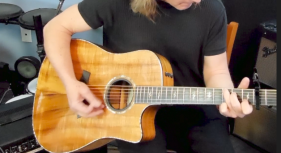
 In this song, Dan has tuned his guitar up one half step. Oh that Dan, you never know what he has up his sleeve. This will, of course, put more stress on your fingers as the string tension will be higher. Don’t worry if you have a smooth playing acoustic. If not, be advised that your fingers may not be happy with you. Read on for a couple solutions I’ve come up with.






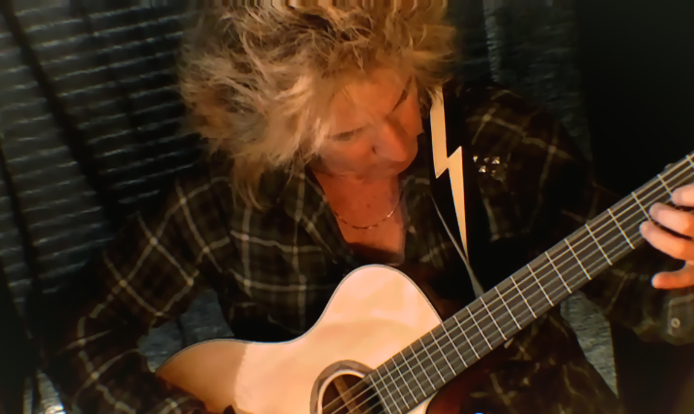


 than this?”John 5 played a blistering four minute long guitar solo during Rob Zombie’s covert walkathon through the crowd. Ya, maybe a little cliche at times but still great. It’s about time he was allowed to cut loose. It wasn’t going to happen with Marilyn Manson as the music wasn’t about long guitar solos. But with Rob’s vibe, it fits perfectly.


 e. The keyboard part at the beginning could have been tweaked a bit better but nevertheless, it was refreshing to see fans of all ages singing along. It was a genius move to cover that gem.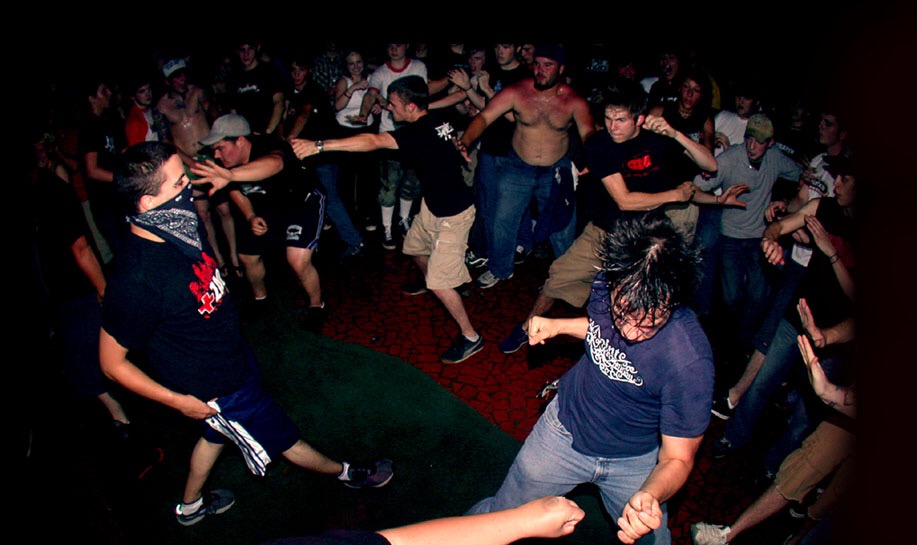




 Lo and behold I hear this music…this guitar and bass drum. Then, I hear the voice. Instantly, I knew it was her. I’m thinking no not again! But, this was different. This song cut through my musical being like a knife. The songs ends and the light turns green. I rush into the parking lot, into the
 Here is what I have so far of the guitar and percussion part for the song. I will have it finished tomorrow and will turn this into the finished product. This should suffice for the next 12 hours.
 @MarkGTR